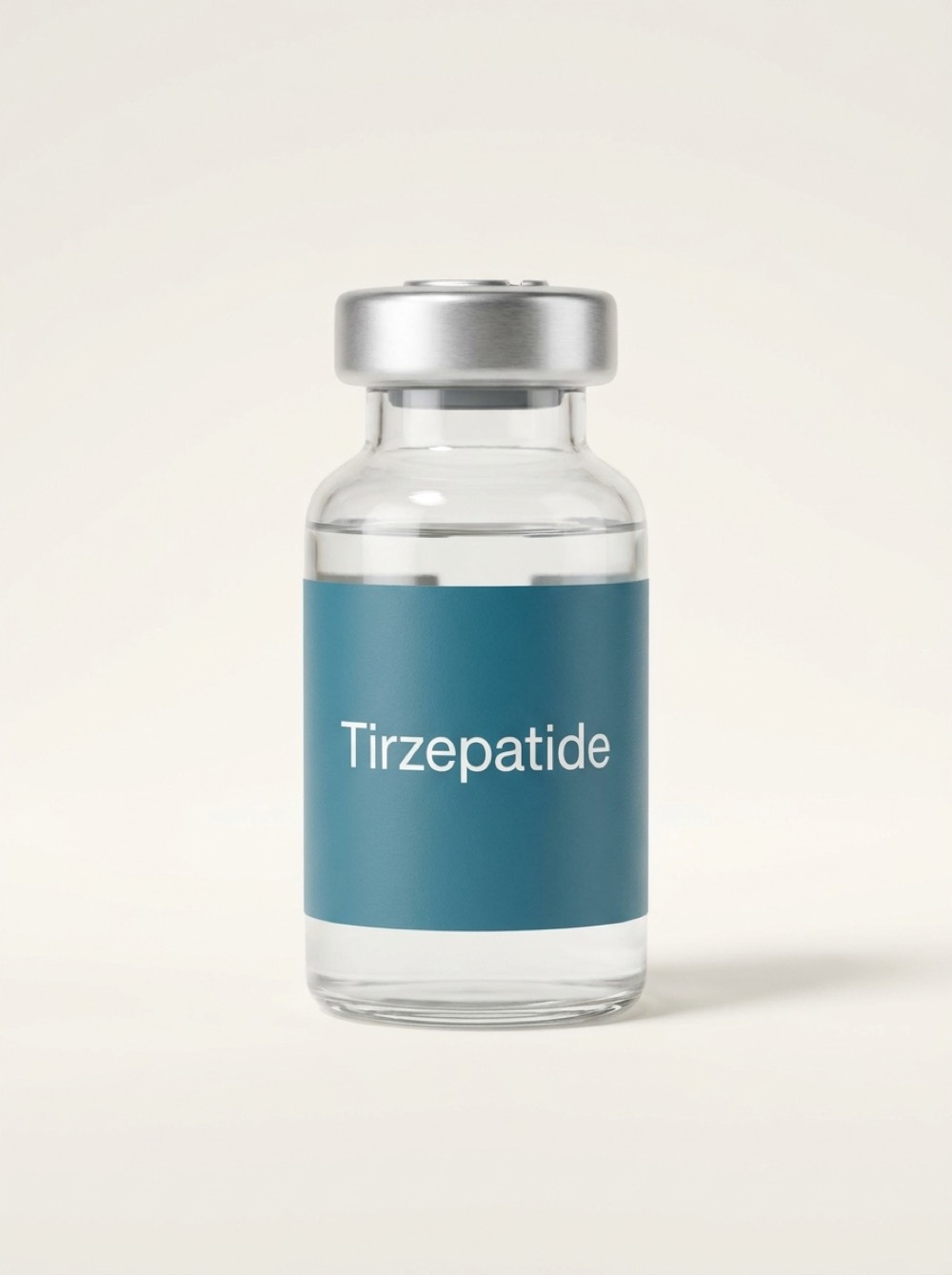
Product photography is representative. Vial size and labeling vary by pharmacy and dose.
Tirzepatide
One injection a week, at a dose your provider sets and adjusts with you. Tirzepatide acts on two receptor pathways instead of one, and providers often reach for it when a single-pathway option has not gone far enough.
Why tirzepatide targets two receptors instead of one
Semaglutide works on a single hormone pathway called GLP-1. Tirzepatide works on that same GLP-1 pathway and adds a second one, GIP. Both hormones are released naturally in your gut after you eat, and both play a role in appetite and blood sugar.
GLP-1, the familiar half
Slows how fast your stomach empties and signals fullness to your brain. This is the same pathway semaglutide uses on its own.
GIP, the second pathway
Works alongside GLP-1 and appears to add to the appetite and metabolic effect rather than duplicate it. It is the main mechanical difference between the two medications.
What that means in practice
In studies comparing the two classes, tirzepatide has generally produced a larger average effect at comparable doses. Averages are not a promise for any one person. Results vary and are not guaranteed.
This is a general explanation of mechanism, not a claim about your outcome. Your provider decides which pathway, or combination, fits your history.
Want a provider's read on this? Answer a few questions and a US-licensed provider tells you what actually fits, if anything does.
Start the assessmentHow the dose usually goes up
Tirzepatide starts low on purpose, then moves up in more, smaller steps than a single-pathway medication typically does. Below is the typical pattern. Your provider sets your schedule and can hold you at a dose, step you up slower, or move you back down.
Typical titration schedule for compounded tirzepatide
| Weeks | Typical weekly dose | What most people notice |
|---|---|---|
| Weeks 1 to 4 | 2.5 mg | The starting dose. It is meant to let your body adjust to both pathways, not to drive results. Most side effects show up here and usually settle within a couple of weeks. |
| Weeks 5 to 8 | 5 mg | The first step up, and only if you handled the starting dose well. Appetite changes are often clearer at this point. |
| Weeks 9 to 12 | 7.5 mg | A common place to settle for people coming from a lower-effect GLP-1. Plenty of patients stay here for months. |
| Weeks 13 to 16 | 10 mg | Your provider steps you up only if progress has stalled and you are tolerating the current dose well. |
| Weeks 17 to 20 | 12.5 mg | A higher step reserved for patients who need it and are tolerating the medication. |
| Week 21 and after | Up to 15 mg | The upper end of the usual range. Many people never get here, and that is fine. |
Same day, every week
Pick a day and stick to it. If you miss a dose and it has been less than four days, take it when you remember. If it has been longer, skip it and go back to your normal day.
Rotate the site
Stomach, thigh, or the back of the arm. Move the spot each week. Your kit comes with everything you need and written instructions.
Speak up early
If a step up is rough, message your care team. Holding a dose longer is normal and costs you nothing. Nobody gets pushed up a ladder on a schedule.
This schedule is a general reference, not medical advice or a prescription. Your provider sets your dose. Compounded medications are not FDA-approved. Results vary and are not guaranteed.
Side effects, plainly
Tirzepatide is a real medication with real side effects, and the profile looks a lot like other GLP-1 medications since it shares that pathway. Most are stomach related, most show up in the first weeks or after a dose increase, and most ease as your body adjusts. Read this part before you start, and ask your provider anything it raises.
The common ones
These are reported often and usually get better with time or a slower dose ramp. Some patients on tirzepatide describe the first two weeks after a step up as more noticeable than they expected.
- Nausea, especially in the first week at a new dose
- Diarrhea or constipation
- Vomiting
- Decreased appetite that feels stronger than expected at first
- Stomach pain, indigestion, or bloating
- Fatigue and headache
- Soreness, redness, or itching at the injection site
What helps: smaller meals, less greasy and fried food, drinking water through the day, and not rushing to the next dose. Your provider can slow the ramp or hold you where you are.
Call your provider right away if
- You have severe stomach pain that will not go away, with or without vomiting, and it may move to your back. This can be a sign of pancreatitis.
- You cannot keep fluids down, or you feel dizzy, weak, or your urine is very dark. That is dehydration, and it can affect your kidneys.
- You have pain in your upper right stomach, fever, yellowing skin or eyes, or clay-colored stools. That can point to a gallbladder problem.
- You notice a lump or swelling in your neck, trouble swallowing, hoarseness, or shortness of breath.
- You have vision changes, especially if you have diabetic eye disease.
- You have signs of low blood sugar such as shakiness, sweating, confusion, or a fast heartbeat, which is more likely if you also take insulin or a sulfonylurea.
- You have a rash, swelling of the face, lips, or tongue, or trouble breathing.
If it feels like an emergency, call 911 or go to the nearest emergency room. Do not wait on a message.
Who should not take tirzepatide
Do not use tirzepatide if you or a family member has had medullary thyroid carcinoma, or if you have Multiple Endocrine Neoplasia syndrome type 2. In animal studies, tirzepatide caused thyroid C-cell tumors. It is not known whether it does that in people.
Tell your provider before you start if you are pregnant, planning to become pregnant, or breastfeeding; if you have had pancreatitis, gallbladder disease, or an eating disorder; if you have gastroparesis or another serious stomach problem; if you have kidney or liver disease; if you have diabetic retinopathy; or if you take insulin, a sulfonylurea, or any other medication for diabetes. Tirzepatide slows how fast your stomach empties, which can change how other oral medications are absorbed, so list everything you take including birth control and supplements.
Tirzepatide is not a treatment for type 1 diabetes and is not for people with a history of severe allergic reaction to tirzepatide or any ingredient in the formulation.
Compounded medications are not FDA-approved. Compounded tirzepatide is prepared by a licensed compounding pharmacy and is not reviewed by the FDA for safety, effectiveness, or quality. Weight-loss results vary and are not guaranteed. This page is general information, not medical advice, and it does not replace a conversation with your provider. Medication is prescribed only if a licensed provider determines it is appropriate after an evaluation. Before you start, you will review and sign our telehealth consent.
Tirzepatide or semaglutide?
Both are once-weekly injections and both are prescribed only when a provider decides they fit. The honest short answer is that tirzepatide is often the second stop, not the first, and your provider decides based on your history and how you have responded so far.
| Tirzepatide | Semaglutide | |
|---|---|---|
| How it works | Acts on two pathways, GLP-1 and GIP. | Acts on the GLP-1 pathway only, which affects appetite and how full you feel. |
| Program price | From $249 a month | From $99 a month |
| How you take it | One injection a week | One injection a week |
| Typical dose range | 2.5 mg up to 15 mg, stepped up over months | 0.25 mg up to 2.4 mg, stepped up over months |
| Common side effects | Similar profile, and some patients report the early weeks feel stronger | Mostly stomach related, heaviest in the first weeks and after a step up |
| Often chosen when | You want the dual pathway option, or semaglutide has not been enough at a full dose | You want the more established option, or the lower monthly price, or you are starting from scratch |
| Switching later | Tell your provider your current medication and dose, and they review whether to continue or change | Same. Nothing about starting one locks you into it. |
This comparison is general information, not medical advice, and it is not a claim that either medication works better for you. Neither is a compounded product reviewed by the FDA. Your provider chooses based on your history, your other medications, and how you respond. Results vary and are not guaranteed.
Still deciding? You do not have to know what you want. That is what the provider review is for.
Start the assessmentWhat patients on tirzepatide say
Individual experiences. They are not a promise of what will happen for you.
"I was on semaglutide for a year and stalled out. My provider walked me through switching to tirzepatide and had me start low again, same as day one. It took a few weeks to notice a difference, and it was worth the patience."
Verified patient · results vary"The step-up schedule has more rungs than I expected, which I actually liked. Every increase felt smaller and more manageable than I braced for."
Verified patient · results vary"Went straight to tirzepatide since my sister had good results. Weeks two and three after each increase were the toughest part for me, but my provider let me hold a dose an extra month and that made it manageable."
Verified patient · results varyQuestions about tirzepatide
What actually makes tirzepatide different from semaglutide?
The mechanism. Semaglutide acts on one hormone pathway, GLP-1. Tirzepatide acts on that same pathway and adds a second one, GIP. Both hormones already exist in your gut and play a role in appetite and blood sugar after a meal. Your provider decides which one, or a switch between them, fits your history.
Should I start on tirzepatide or semaglutide?
That is a provider decision, not a preference. Many people start on semaglutide because it is the more established option and costs less, then move to tirzepatide later if progress stalls at a full dose. Some providers start certain patients on tirzepatide directly based on history. Neither path is wrong, and switching later is normal.
Is compounded tirzepatide the same as the brand-name version?
No. Compounded tirzepatide is prepared by a licensed compounding pharmacy and is not FDA-approved. Brand-name products are separately approved and are a different product with different labeling. We do not claim they are equivalent. Your provider will explain what compounded means for you before you start.
I heard tirzepatide hits harder in the first weeks. Is that true?
Some patients describe it that way, but it varies person to person and depends heavily on how carefully the dose is stepped up. The titration schedule exists specifically to keep the early weeks manageable. If a step up feels rough, message your care team before your next dose. Holding a dose longer costs nothing extra.
What does the $249 cover, and what is not included?
It covers your provider visit and review, your medication when it is prescribed, dose changes, injection supplies, monthly check-ins, unlimited messaging with your care team, and shipping. It does not cover lab work if your provider orders it outside our program, or care from other clinicians. No insurance is billed. You are not charged at all if a provider decides tirzepatide is not appropriate for you.
I am switching from semaglutide. What happens to my dose?
Tell us your current medication, your current dose, and how long you have been on it during the health check. Because tirzepatide's dosing is measured differently, most providers restart the titration at a low tirzepatide dose rather than trying to match numbers across two different medications. That is a safety step, not a step backward.
Do I have to stay on it forever?
That is a conversation with your provider, not a policy. Some people taper down after they reach a goal and work on holding it with food and activity changes. Some stay on a maintenance dose. Weight often comes back when a GLP-1 or GLP-1/GIP medication stops, so your provider will plan the exit with you rather than leaving you to guess. You can cancel your program anytime, and one message to the care team is enough to do it.
Which states can you ship to?
Nationwide. Medication ships from a US licensed pharmacy and typically arrives in 3 to 5 days after a provider prescribes. Details are on the shipping page.
How long until it shows up?
A licensed provider usually reviews your intake within 24 to 48 hours. If you are approved, your medication ships from a US-licensed pharmacy and generally arrives in 3 to 5 days in plain packaging with no branding on the outside.
Still have a question? Message our care team or read the full FAQ.
Find out if tirzepatide is a fit
The health check takes about two minutes. A US-licensed provider reads it, usually within 24 to 48 hours, and tells you either way.
Checking if you qualify is free. You only pay if a provider prescribes.
Compounded medications are not FDA-approved and are not reviewed by the FDA for safety, effectiveness, or quality. Medication is prescribed only if a licensed provider determines treatment is appropriate after an evaluation. Results vary and are not guaranteed. Tirzepatide is not for everyone. Do not use it if you or a family member has had medullary thyroid carcinoma or if you have Multiple Endocrine Neoplasia syndrome type 2, and tell your provider if you are pregnant, planning to become pregnant, or breastfeeding, or if you have a history of pancreatitis. Program pricing shown is the monthly cost and includes the provider visit, prescribed medication, dose titration, monthly check-ins, and shipping. No insurance is billed. We ship nationwide from a US licensed pharmacy. This page is general information and not medical advice.